
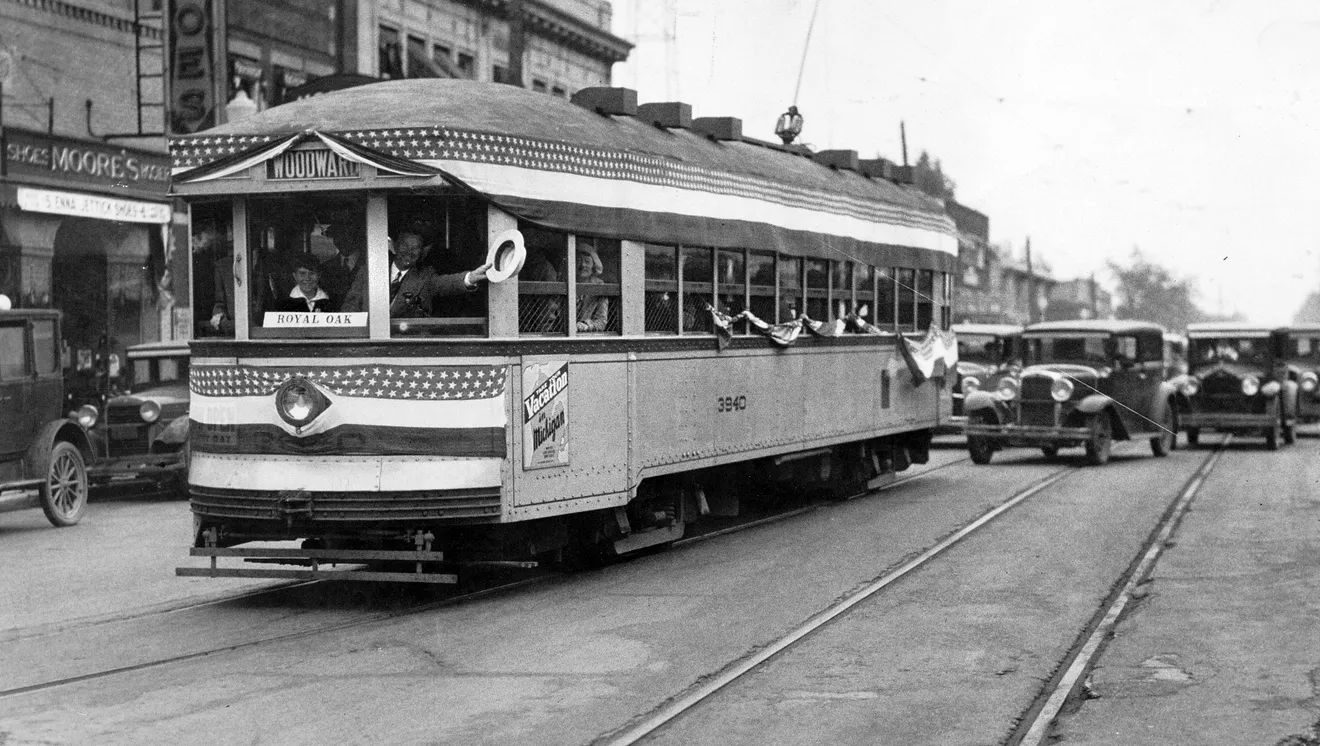

Clang, clang, clang went the trolley, ding, ding, ding went the bell, zing, zing, zing went my heartstrings, but then the age of American streetcars fell. As much as we all wish we could live a Judy Garland fantasy zipping through our home cities of choice, streetcars have become a vanishingly rare mode of transit in the United States compared to their peak just before the Second World War. Many now serve more as tourist or historic attractions than as mass transit, but in their heyday, especially here in Detroit, they could be seen running on most major roads and avenues at frequencies of up to every 90 seconds. Yes, seconds. Though the service and the vehicles may be gone, evidence of Detroit’s streetcars can still be found in every corner of the city. The Q-Line follows part of the original Woodward Avenue route (albeit on modern curb-running tracks), the remains of the Michigan Avenue tracks can still be seen in Corktown, and major road rebuilds inevitably uncover buried rails, some dating back to the 1860s.
Often less thought of, however, is the effect streetcars had on the very fabric of Detroit’s neighborhoods. As horse-drawn and later electric streetcar service expanded along Detroit’s boulevards- largely as speculative business ventures led by the Detroit United Railway Company- numerous neighborhoods developed into the communities we recognize today. Developers and families alike were drawn by the accessibility these new services offered, making it possible to travel across the city and even throughout the region via the related interurban lines to far-flung places like Port Huron, Saginaw, Toledo, and Kalamazoo (to see your favorite gal there, of course). The benefits of this early form of transit-oriented development can still be felt today, long after the tracks have disappeared beneath decades of concrete and asphalt.
Many of Detroit’s most desirable neighborhoods and inner-ring suburbs owe much of their growth and character to the arrival of streetcar and interurban service. Corktown, Woodbridge, and The Villages/Islandview, as well as places like Ferndale, Royal Oak, and Dearborn, all experienced significant growth only after city streetcar lines or interurban service reached their communities. Many of these neighborhoods share similar vernacular architecture, scaled up or down depending on the income level developers anticipated for their residents. Woodbridge, for example, features many late Victorian and American Foursquare homes built on larger lots with greater ornamentation to attract upper-middle-class professionals and families, while Islandview was marketed more toward working-class families and consequently contains a greater number of duplexes and small apartment and rowhouses.
But why do these neighborhoods and suburbs remain so attractive more than 75 years after streetcar and interurban services reached the end of their lines? In a word; Density. Stroll through any of these neighborhoods today, or visit the oldest portions of the aforementioned suburbs, and you’ll be hard-pressed to find large front yards, long driveways, or many of the hallmarks of postwar suburban zoning and land use. Density like this supports local businesses, makes walking practical, offers more housing choices, and encourages social interaction, creating the very essence of community.
Because residents knew the streetcars would always follow the same route and operate on reliable schedules, developers felt confident building densely along those corridors. That concentration of people supported local businesses, schools, libraries, churches, union halls, entertainment venues, and other gathering places, allowing many neighborhoods to become largely self-contained communities. In many ways, they were the precursor to today’s oft-discussed “20-minute city,” where the necessities of daily life are within walkable or rideable distance every day. They provided the “good bones” necessary for timeless districts that can endure and renew as necessary, much like a well-built old home can withstand a century or more.
The story of Detroit’s streetcars is about far more than rails buried beneath asphalt or vintage photographs of trolleys gliding down Woodward Avenue. Their greatest legacy is the communities they helped create. Long before planners coined terms like “transit-oriented development” or the “20-minute city,” Detroit’s streetcar suburbs demonstrated that neighborhoods built around reliable transportation, walkability, and a mix of homes, businesses, and public spaces could thrive for generations. Even after the last cars stopped running, those qualities endured. Today, as cities across North America search for ways to build more connected, livable communities, the answers may not lie in inventing something entirely new. Instead, they may be found by looking at our feet,beyond the pavement, at the forgotten tracks that once shaped the neighborhoods we still love the most.
by Davy Webb
Leave a Reply