

This interview was done in collaboration with Detroit Development News and is being replicated on their Substack, check it out here!
Tim Flintoff of 4545 Architecture joined Strong Towns Detroit for a panel discussion regarding development in the city, roadblocks that pop up, and what the city could do to alleviate some of these issues. The central theme of the conversation centered around the recent proposal to amend some of the zoning code in order to make it easier to build housing, which you can read all about in our last blog post. Tim sat down with us afterwards to discuss his role in the process, which you’ll see is much more involved than simply doing the architectural drawings.
For clarity, the questions are in bold and Tim’s responses are below…
How did you get started living and working in the city?
I moved to Woodbridge about 15 years ago. I came here to go to college, then moved out to the suburbs for a little bit but my wife and I were both working downtown so we decided to move back. I worked for a larger firm for a bit but went out on my own in 2017 and have done mostly smaller homes and multifamily projects.
What is the role of an architect when it comes to a new development? Does it go beyond simply designing the building itself?
The front-end process, the drawings, are the easy part, there’s only so many ways you can build a building. The hard part is navigating the process of getting it from drawings to actually getting built, getting through all the approvals with the city.
People will approach us with a property in mind and simply as, “how many units can we get on it”, so we’ll do a quick study, and we can quickly determine whether they should go by right or look at variances. If you stay by right, you can save three or four months, but you may be sacrificing space or units.
We can take a look at zoning and see how that will affect what can be built. One of the biggest differences is between R2 and R3, R2 is conditional for townhome and it’s a maximum of 8, where R3 is by right and it’s a maximum of 12.
Are more people coming to you asking for these types of dense, missing middle projects? Townhomes, quads, small apartments?
Some of it has to do with the fact that the Land Bank only has so many large lots left, but they have a bunch of small infill lots. I think the city wants to see small infill, two family, 8–10-unit buildings, as opposed to mega-townhomes developments. And we work with a lot of small developers, and I think this size works well for them. A lot of our customers have a small capital stack who want to build something small and roll it into their next project. One of our customers was doing single family house renovations and decided to take on a townhome project during COVID, which they found success with.
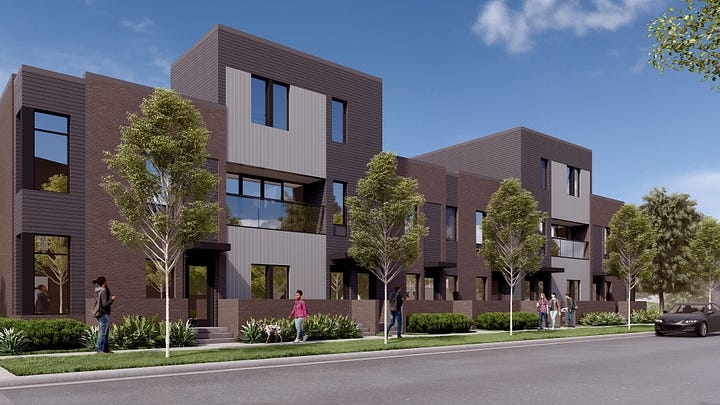
For-sale townhomes seem to be a recent trend…
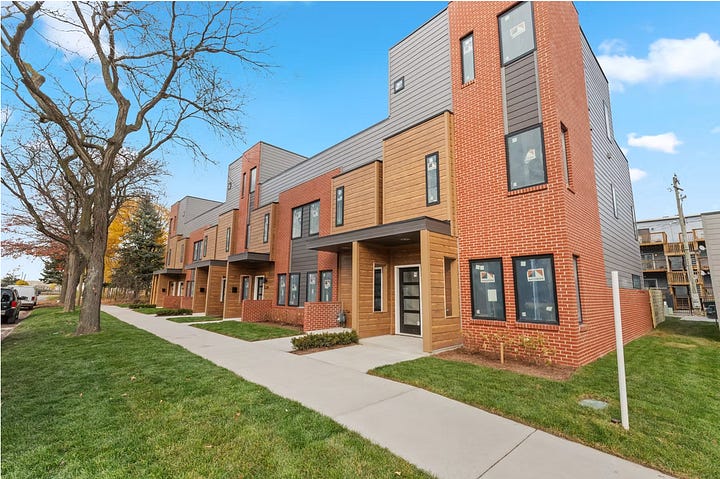
Yeah, a for-sale model works well with townhomes. It’s a bit about the design, apartments tend to be 800 or so square feet, and townhomes tend to be 1,200+ square feet, with a staircase and a few floors. We found the two story or three-story townhome to be ideal, with features like a backyard and detached garage. Compared to the style where parking is underneath, the detached garage in the back helps keep the main living space on the first floor and engage with the street better. We’ve done a few with a garage and parking in the front, but the city doesn’t like that and has shut some projects down. But it’s tough in some areas where the alleys aren’t as accessible, we’ve run into that a few times.
There seems to be a lot more that goes into design.
The city process is very drawn out. We guide people through the whole process; we understand how to communicate with the planning department and get design review. Typically, that is a requirement of the sale of a land bank property. You may have to establish condo documents, so we’ll bring in a civil engineer to create those, and then we’ll have a lawyer we work with who handles recording with Wayne County. There are some ways to save time if you’ve done it before.
What are some roadblocks that get in the way during the process?
Parking is often the biggest thing. Working in the Midtown area especially, the lots aren’t big enough to get everything you want, ground floor amenities and parking. Parking is the biggest challenge. Getting things rezoned too, even if you get your lot rezoned, there can be issues with the adjoining lots. For example, we’re doing a project in SD1, but it’s adjacent to R2, so there’s a lot of separation requirements, a 10-foot setback green buffer, masonry wall screening, and vegetation. We went through the process to rezone so we could avoid getting variances, but the city didn’t rezone everything they had originally planned. They came back and told us that the rezoning went through but they pulled back from rezoning the larger area, which really affected our plans.
When we have a project that isn’t going to fit with the current zoning, we can either go for a full rezone, or we can look for those smaller variances. There’s a project now where we went for a Board of Zoning Appeals Hardship approval instead of a rezoning, at the City’s suggestion, and it would have been a much easier and quicker process if we just went for a rezone. So, it’s not always a clear path and it can cause some serious delays.
It seems like the city wants development, but where are these snags usually coming from?
Just navigating the city and finding the right person to help you out when you need it. The city is big and it’s easy to slip through the cracks, so the more you do it, the more you learn about how to get it done. Being Detroit based and dealing with mostly Detroit projects, we’ve been able to assist more and more with developers and contractors. We’ve continued to expand our role within projects as we successfully navigate projects. A lot of our customers ask us to submit documents that contractors normally would because we know how to engage the different reviews, track the comments, and revise the drawings. You’re never going to get everything approved the first time around, which is typical with any city, but there’s a bunch of reviews here, with zoning often reviewing and then assigning additional review to a bunch of other departments. I know when I submit, it’s going to be probably 21 days before it even gets its first review.
Besides zoning, I know I’ve heard issues raised with complications and cost in getting new buildings connected to utilities, have you had experience with that?
Yeah, that can be a huge issue. We had a for-sale building that was completely finished but we couldn’t get final approval because we didn’t have water and sewer connections yet. We were delayed for about a month and a half, buyers couldn’t move in, it was a big pain. There are certain things that impact these areas, like permitting review and right-of-way permits, that may be able to be streamlined because you’re essentially doing the same review twice that each eat up a good amount of time in the total project.
What’s something the city is doing well?
Planning department design review. Not every city has a strong hand in critiquing design and forcing developers to meet certain requirements, but Detroit takes a fairly active hand in it. This and the PPR process, the Preliminary Plan Review, it’s great to have this roadmap early on. When we first started doing townhouses, there were things we didn’t know, like utilities in the alley and what the requirements go along with it. The PPR was helpful in identifying these issues early on.
What are some areas you are excited about working in?
We’ve done a lot of work in North Corktown and are doing more in the North End. We’ve got a few projects in Midtown as well. We’ve been approached about a few projects near Six Mile and Seven Mile. I think people who have property around the city are seeing opportunity and want to seize on it. It’s been nice to see things spread around the city, especially when we build for sale projects, it’s great to see opportunities for residents to move in.
There seems to be great opportunity and need for small, incremental development. What advice would you have?
Definitely reach out to an expert early on. We can take a look at a site and triage it pretty quickly, I have people all the time calling and saying, “I’ve got this property, what can I do on it?”. Without even getting into a drawing, we can tell you within a few units what you can build. From there you can get a quick concept study done for a few thousand dollars, just to see what the possibilities are.
There are some great programs out there, Chase Cantrell with Building Community Values, others like Capital Impact Partners. There are a lot of different avenues and the more people that get into it will help bring in more people to the city. You can’t just do it with one large developer. The more diversity of projects, you get diversity of looks and sizes. We like to do modern work, but we’ll cater to the client.
My neighborhood, Woodbridge, is a great example of how diversity can make a strong neighborhood. It was mostly large single-family homes back when it was a streetcar suburb, then after the depression, it was a lot of multifamily homes. Now you have a lot of different types of styles and types of homes, it makes for a great place to live.
 Strong Towns Detroit
Leave a comment